
Volunteering at International Bird Rescue
Well, folks, it’s been over two months since I returned from San Pedro, LA! I’d say it’s high time for me to share with you what I got up to while volunteering at International Bird Rescue.
This is a bit of a combo of “day in the life” and overall experience, plus my favourite highlights. Join me in reliving these intense two weeks!
The journey begins
Each morning (and every afternoon post-shift), we had to navigate our way to and from the center in San Pedro. The distance between our motel in downtown San Pedro and the center is only 2.5 miles, but we were car-free in LA. This initially presented a bit of a conundrum: too far to walk (without having to get up at the crack of dawn and losing precious sleep), and we were on a budget, so Ubering each day was out of the question. Initially, we made use of Lime scooters, thinking they would be a bit more cost-effective and quick. That turned out to not quite be the case, and I’ve vowed to never again rely on them for long-distance transportation. They cost the same as an Uber! At least in LA. Egads.
Our remaining option was public transit, a la the LA bus system, so bus is what we did.
But! The bus didn’t quite get us to the center…we still had to walk about a quarter of a mile from where it dropped us off. Straight up a hill!
Fortunately, the walk wove us through a residential neighbourhood and climbed to a decent view of the coastline, so when we stopped to catch our breath, we could also admire the various succulents and other tropical bushes and trees lining the sidewalks and yards. My earlier post, The Red Fence – came about as a result of huffing up the hill!
At the center
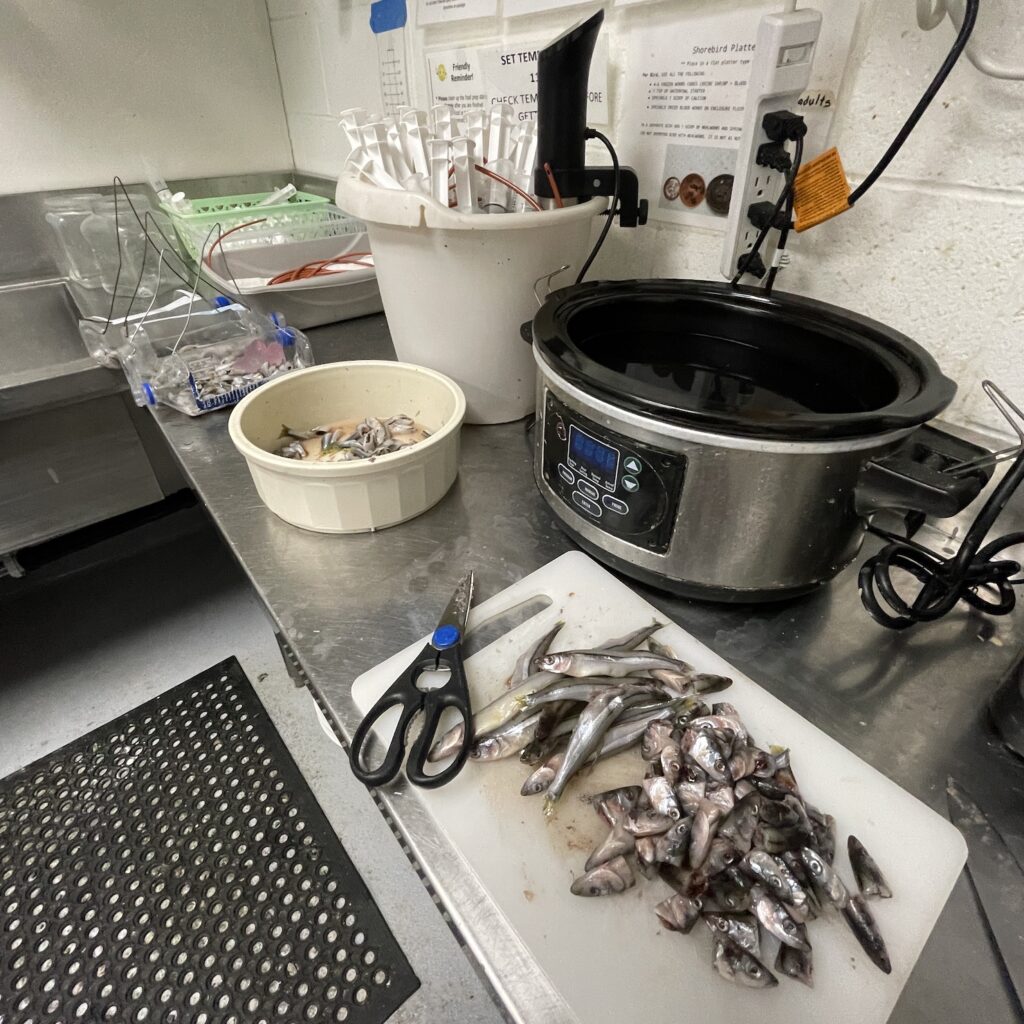
Mornings at the center were like clockwork: we checked in, ate a quick breakfast, and then headed in to feed da birbs. It turns out, what seems like a simple task – feeding – is itself a whole series of sub-tasks: food containers must be collected from the pens to be cleaned and sanitized; fish must be cut up into pieces or dished out whole, depending on the patients in care; and then it must all be delivered to their respective locations.
I should mention here that walking food to the pens is not necessarily as easy-breezy as you might imagine. There is a bit of a gauntlet between leaving the building and venturing forth outside! We were warned, numerous times, of the veritable cast of wild bird characters that await, looking for a free meal: Sticks, a heron who watchfully perches atop a light post above the outdoor pools, waiting for the perfect opportunity to swoop in and pilfer someone’s lunch. Buckets, a gull, who, we learned, has been known to “clock” volunteers in (presumably?) the back of the head as he dive-bombs for the bowls of herring they’re walking to the pelican pen (he also brings an entourage with him). And finally, Rudy, a raven. He hops around on the ground a lot.
What it means to care for water birds
Caring for pelagic water birds in a rehab setting is full-on and full-time. Feeding takes on a whole new meaning. In addition to all the subtasks associated with the act of feeding, there are the types of fish, quantities, preparation, and timing.
Fish must be thawed and rinsed. Why rinsed? The water in the pools must stay as clean as possible: too much oil from oily fish is bad for water quality and ruins a wild bird’s waterproofing. The species of fish we were using to feed was particularly oily, and so, we rinsed the fish.
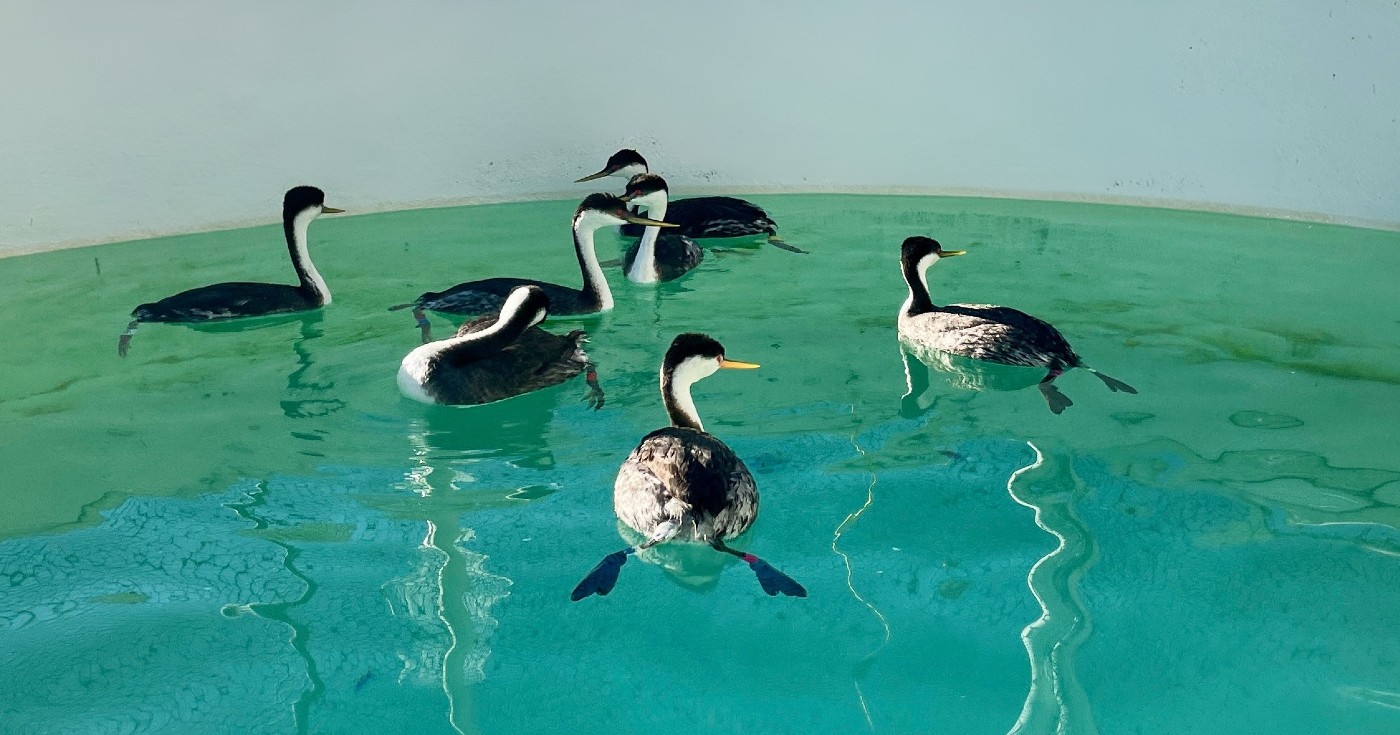
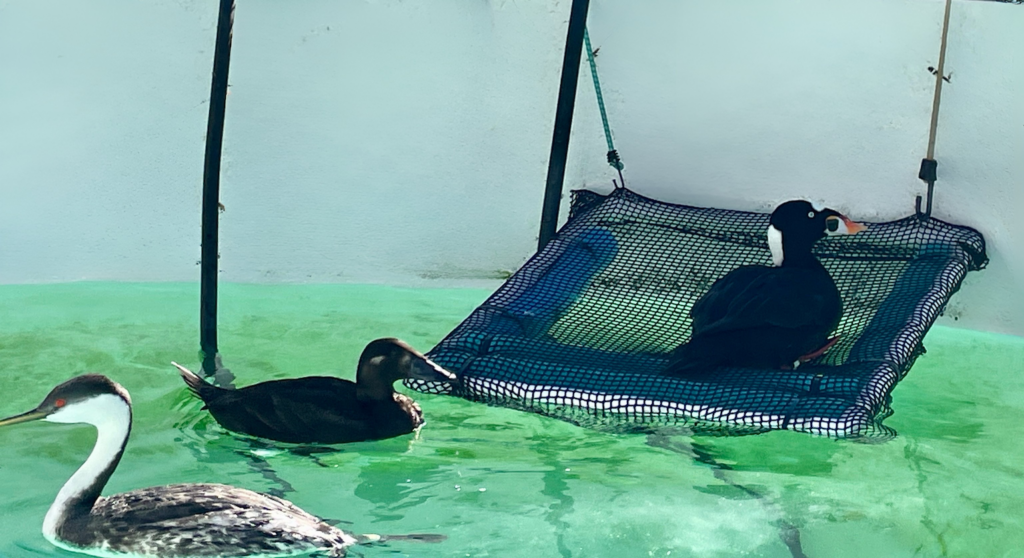
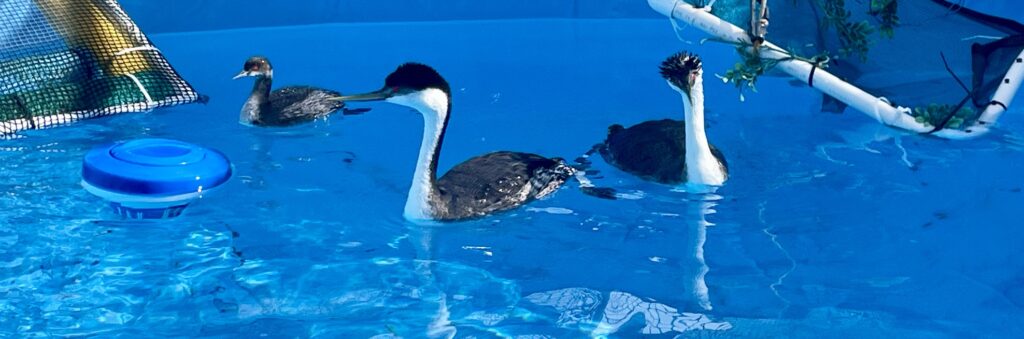
The fish also can’t be too frozen, but they can’t be too warm either. It matters what type of fish goes to each patient and how they are presented. For those in the pelagic pools (of which there are four and at the time of our visit contained a mix of species, including Western Grebes, Surf Scoters, and Red-Throated Loons), they receive the fish mentioned above: a mix of cut pieces and whole fish. Volunteer CJ, a firecracker of a human, directed me on how to slice them just so, using the best scissors to demonstrate (yes, we cut fish with scissors; it’s more efficient that way).
But some birds got other meals. Eared Grebes, for example. Because they are so small (one fits into the palm of my hand!), their food must also be small. For some reason, they also received a dressing of krill mixed in with their fish and a side of mealworms. I forgot to ask why.
Then there were the pelican aviaries, which, while we were there, housed a combination of Brown Pelicans and Western Gulls. They received herring, straight up, in a bowl of water.
Mustn’t forget about the Canada Goose (no, we didn’t bring her with us 😂) – she had her own special food and a bowl of spinach, which she seemed to like throwing around her enclosure. She’s a feisty one (even with a damaged wing!).
Last but certainly not least, the solitary Royal Tern, a stout little seabird with cute feet and a standoffish attitude (I mean, fair enough – I probably would be too if a giant alien human wandered into my living room offering me food). He had a small dish with small fish, ’cause he’s a small dude!
Just when the morning feeding frenzy is abating, it’s time to do it all over again – the birds must always have some food available. It’s a never-ending task.
Once the first feeding was out of the way, though, we moved on to other tasks. Like washing dishes. And mopping floors. And pool siphoning! Did you know I’m an expert pool siphoner now? 😜 I didn’t know I had it in me, nor did I ever think siphoning a pool would be something I’d be proud of, but gosh darned it, I was good at it!
Miles and piles of laundry (and other things)
I was describing to a friend shortly after I returned what it was like to volunteer at the center, and I mentioned that when we weren’t wrangling birds, we were either in the kitchen or doing laundry. He seemed puzzled and asked me what that was about, and only then did it occur to me that maybe that’s a bit odd. “You’re at a bird rescue center, and you’re doing laundry?”
Well, yes.
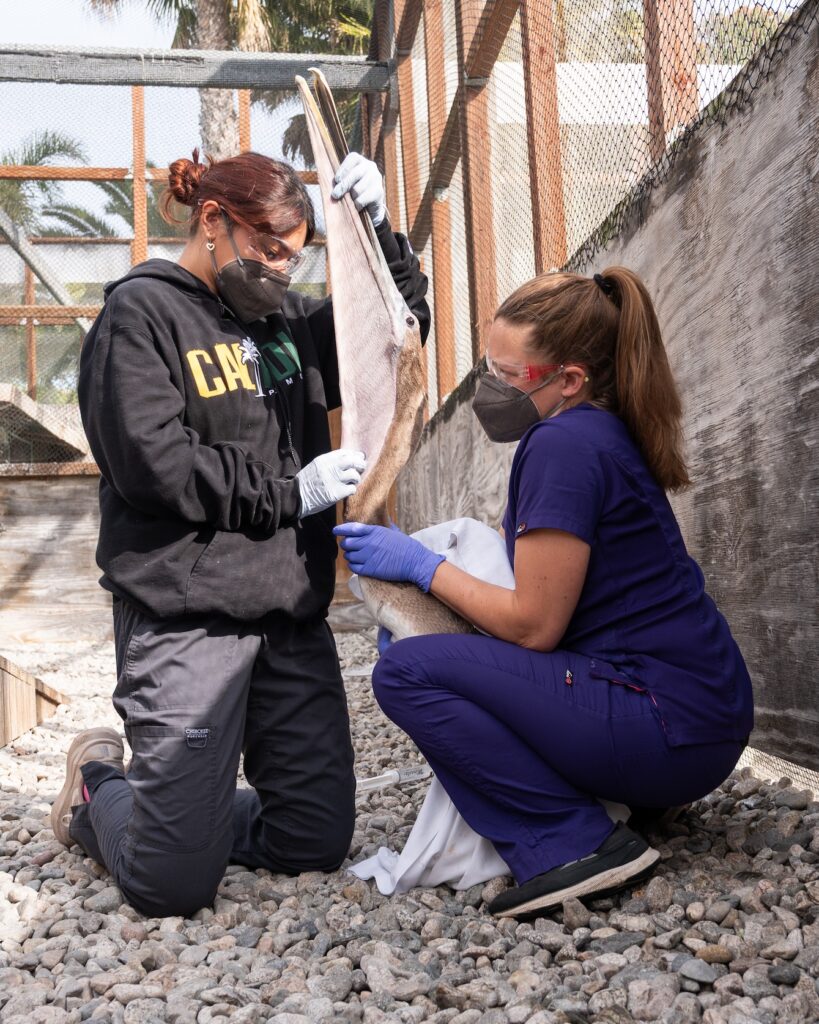
Why the laundry, you might be asking? The center handles wild birds all day, every day: feeding, cleaning oiled birds, administering medication, and conducting checkups. While we try to handle the birds as little as possible, a certain amount is inevitable: when they’re received, moving them to wash/dry stations, in and out of the pools, etc. It’s hard to handle a wild bird – they basically think we’re the predator and they react accordingly! Given that, it can be a stressful experience for them, so we try to mitigate it as much as possible by using pillowcases to keep them safely “burritoed” with their wings, feet, and heads tucked up.
Obviously, though, a pillowcase won’t cut it for a goose, or a pelican. For those, we employ bedsheets. Yes, bedsheets! There were a few times at the center when an intern and I had to wrangle Ms. Canada Goose or one of the Brown Pelicans, and let me tell you, sometimes even a bedsheet didn’t feel like enough!
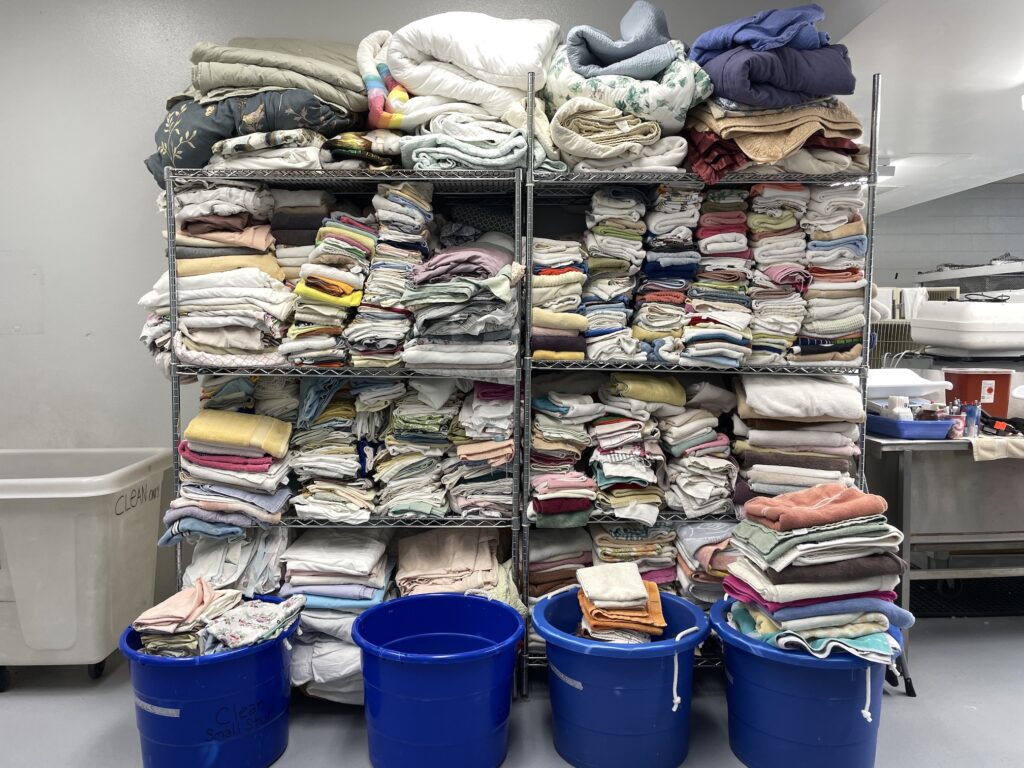
Just once in the two weeks we were there did I catch the clean laundry bin empty. Every other time, there was a mountain of clean towels, pillowcases, and bedsheets to fold and put away on the floor-to-ceiling metal rack shelves. Both washing machines and dryers were full, too.
Being a volunteer at this center taught me a lot of specifics about caring for water birds, yes. It’s also taught me how to relate to work that never ends. When the work is endless, we humans must decide when we need to step away from it. This is the miracle of a solid volunteer contingent: when one person needs to step away from a task, another steps in to take up the baton. I had a visceral experience with this on one of my first days in the kitchen dish pit: I spent over an hour cleaning dishes, thinking, “I’ll stop once I finish this last dish,” but the dishes quite literally never stopped. I finally had to stop with dishes left in the sink. Sometimes that’s just the way it goes!
Getting to know wild birds
Because Eva and I were at the center for almost two weeks, we had the opportunity to undertake just about every task it’s possible to undertake as a volunteer. Beyond washing dishes, feedings, and laundry, we also acted as bird handlers for the wildlife vet technicians and interns on staff. This is the job that probably everyone who wants to volunteer at any place with animals dreams about, and I’m so grateful to have had the opportunity to do so…but in actual fact, this task requires some chutzpah!
I mean, it’s not often you’re handed a pillowcase and a net and told to go out there and lasso a wild Western Grebe from a pool, burrito it in a pillowcase, and help keep it calm while it gets a check-up, medication, and feeding. The birds dodge our attempts to scoop them from the pool, but even once we manage to safely lasso a Grebe, we have to handle it firmly yet carefully and delicately. We also have to remember to keep our voices down so as not to startle them. Making sure the pillowcase stays secure, and remaining calm when, invariably, a bird wiggles its head free and starts squawking. Understanding the general anatomy of the various pelagic birds in care so you know how best to handle them (pelicans, grebes, and cormorants, for example, all require different handling techniques!). And on and on!
Oh yes, and in case you are wondering (I’m sure you are)…we got pooped on a lot.
Highlights of the trip
While volunteering at the center was a lot of work, it was also rewarding, and, for a bird nerd like me, just plain cool to have the opportunity to interact with so many new-to-me pelagic bird species.
Here are some highlights:
- Assisting with an intake for a cormorant. She came in with a triple-barbed fishhook stuck in its neck. >.< I had never seen these birds up close, only from a distance as they rested on rocks offshore from Vancouver Island. Their feather patterns are gorgeous.
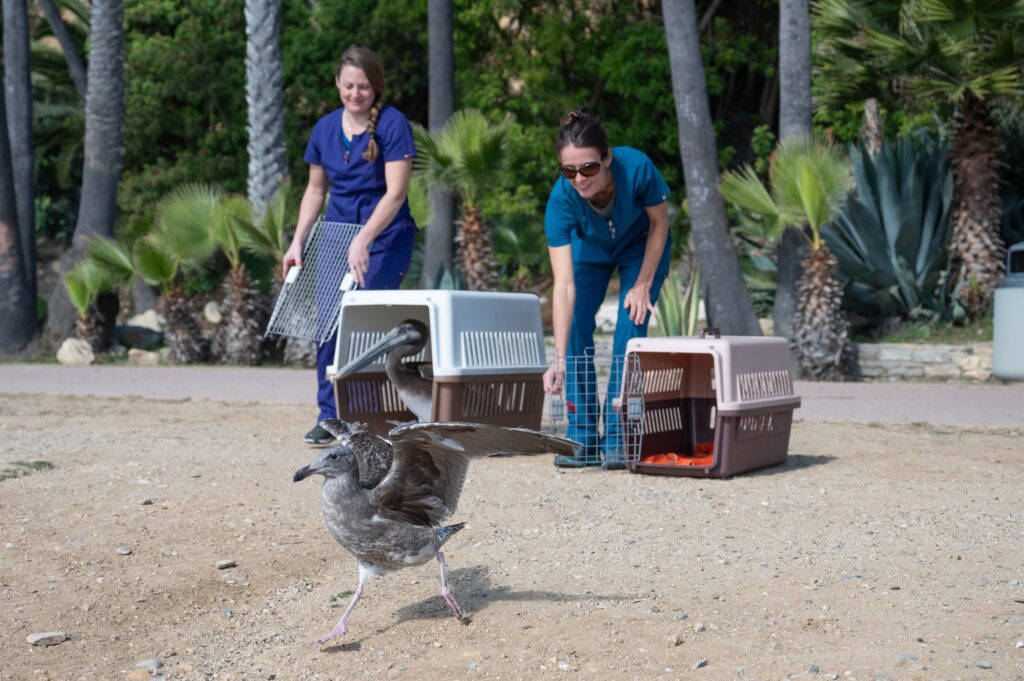
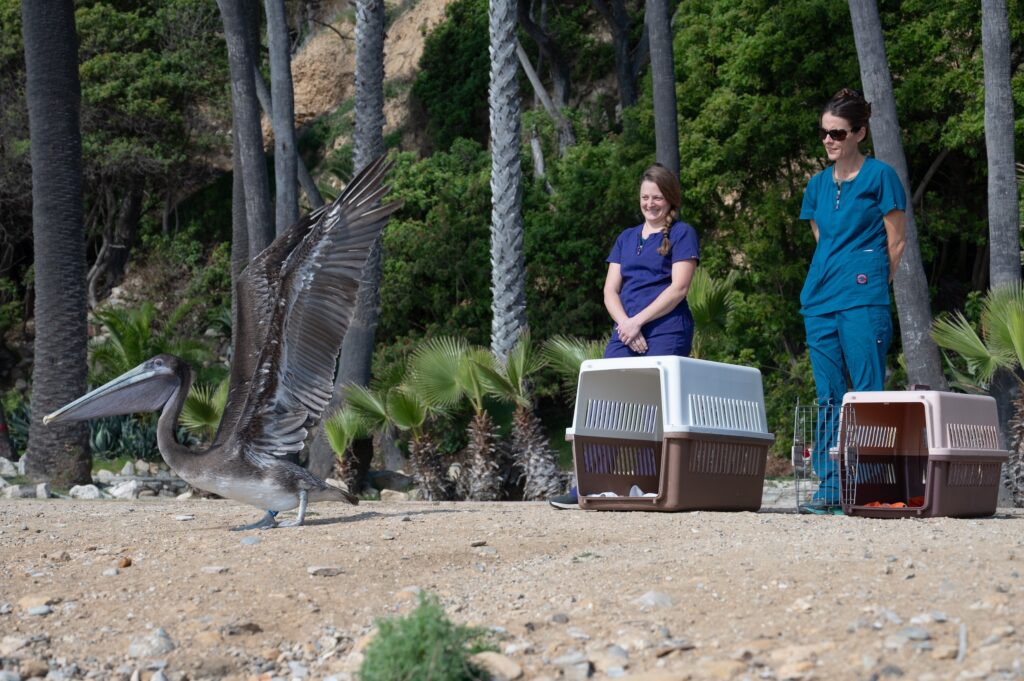
- Assisting with two bird releases, a gull and a Brown Pelican. This is what makes all the work worth it: seeing the birds take off, back to the wild where they belong. My heart soared right along with them!
- Learning how to handle and feed Western Grebes, Surf Scoters, and Common Murres. Birds have so much personality. It was an honour to get to know them a bit more!
- Assisting with two oiled bird washes. Most of the birds in care at the time of our visit were coming in because they had gotten caught up in natural oil seeps in the nearshore environment. The process of cleaning oiled birds is lengthy and requires a lot of patience and a calm attitude. It can be a nerve-wracking process, but ultimately, if all goes right, the result is a clean, waterproofed bird. Yes, they use Dawn dish soap. It’s amazing how well it works!
- Helping wrangle and feed Brown Pelicans. I can’t even begin to tell you how wild both of these tasks were! One thing I learned about handling pelicans is that they don’t use their bills for breathing (unlike other pelagic bird species). To prevent suffocation, we have to always keep a gap in their bill, which means sliding a finger between their bill. This, in conjunction with keeping a very large seabird calm under a very large bedsheet, is a lot to think about!
- Learning about grebe and loon feet. I knew these birds had special feet, different from other water birds, but I had no idea they were so sensitive and delicate. They require a lot of care and attention.
Time flies when you’re with the birds
Phew! What an intense two weeks, but it flew by! We devoted most of our trip to volunteering at the center, with a couple of days off to dilly dally around San Pedro, Long Beach, and Venice Beach. (You might see photos from those excursions in another post.)
I should mention that not all of what I wrote about here happened every day. Feedings, laundry, dishes, pool siphoning, cleaning, helping the staff handle birds…those things happened daily, yes. That was most of the work! It was neat to be involved with some of the more “bigger ticket” items like releases and intakes, but they were rarer. Still, it was all fascinating. What a learning opportunity!
I’m grateful to the folks at International Bird Rescue for showing us the ropes and being willing to answer our many questions. As I mentioned in my first post about this trip, the purpose for Eva and me was to learn more about caring for grebes and loons in a rehabilitation setting, and I think we accomplished our mission. We certainly learned more than we ever thought possible about Grebe feet!
Any questions? 🤓

Yes! I’m suddenly so curious about grebe feet! 😂 Can you share a random fact?
Hehe! Grebe feet are neat! 😁 I would be happy to oblige with a fact! Here’s what’s interesting about their feet and why it matters for rehabbers:
Their legs are positioned towards the back of their body, and they have broad, lobed toes, which act like an oar when they swim and dive. They were so cool to watch glide around in the pools at the center! But because of the unique shape of their feet and the position of their legs, they’re not well-suited to walk on land. If they get stranded (for example, if they haul themselves out of oil-slicked water), they’re liable to fall over (injuring their keel, aka chest) and hurt their feet. It makes for a bit of a tricky patient to rehab – they need to come out of the water to be cared for and attended to, but they can’t stand on solid ground. At this center, they used mesh-net bottoms to house the birds pre- and post-wash (from being oiled), but the objective is to get them out of the pens and into the pools as quickly as possible and reduce damage to their feet.
Another fun fact, because I’m on a roll 🤓, is that while grebes resemble loons, they’re actually related to flamingos! 🦩
They can’t walk on land?! I didn’t know that was possible for creatures with feet! How fascinating! Fun that they’re related to flamingos too 😀 Thanks for sharing those fun facts!